
Consistent pseudonymization
The same email becomes the same masked value every time. Your support team can still trace an issue through a ticket and correlate what's going wrong — without ever seeing who it belongs to.
Ready. Aim. Redactifire!
SELF-HOSTED · REDACT PII, CUI, OUO & ANYTHING ELSE
Privacy-first, self-hosted leak prevention: Redactifire finds and masks PII, CUI, OUO, and other sensitive data in log files, HAR captures, and support bundles — deterministically and consistently, entirely inside your own network.
THE 3 AM SCENARIO
A major defect just took a system offline and your team can't diagnose it alone — but the logs that would explain what's happening are full of usernames, IPs, hostnames, and account data nobody outside your network is allowed to see. You need to get someone real information, fast, without waiting on legal or exposing customer data to do it.
Search-and-replace by eye, under pressure, while the system is still down. Miss one IP and you've leaked something anyway. Redact too aggressively and the file's useless for actually diagnosing the defect.
Works today. Breaks the next time the log format changes or a new field shows up. Someone has to own it forever, and at 3 AM during an outage is exactly when nobody wants to be debugging their own redaction tooling too.
Get a consistently sanitized log back in minutes, with an audit trail proving exactly what was masked and how. No script to maintain, no manual pass, no guessing whether you caught everything.
HOW IT WORKS
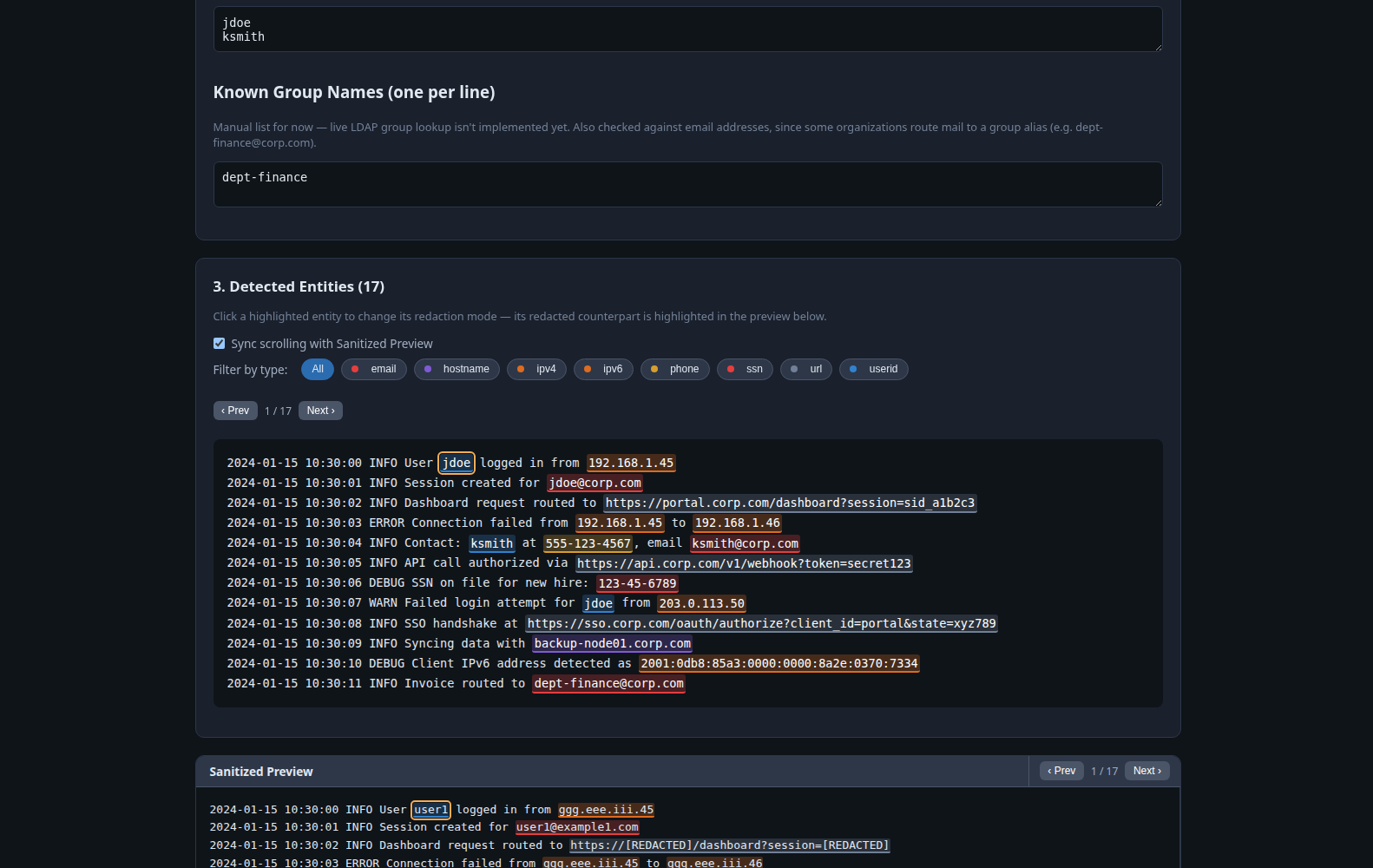
Redactifire doesn't just find-and-replace. It classifies each match — email, hostname, IP, SSN, credit card, user ID — and remembers the mapping, so the same value redacts the same way every time, across every file in the job.
FEATURES
The same email becomes the same masked value every time. Your support team can still trace an issue through a ticket and correlate what's going wrong — without ever seeing who it belongs to.
Suppress, pseudonymize, or partially mask — down to which octet of an IP address or which digits of an SSN or credit card number survive.
Exempt specific values from an otherwise type-wide rule — redact every email address except the one your vendor actually needs to see.
Highlight anything detection didn't catch and mark it yourself — it's redacted from then on, everywhere it appears.
Redaction rules, presets, and per-value overrides persist across sessions. Set it up once, sanitize the next file in seconds.
Change the text or the rules and watch the sanitized output update instantly — no re-run, no guessing what a mode change will do.
Upload a whole batch at once — the same value redacts identically across every file in the session, so cross-referencing stays possible.
Point it at your directory to recognize real usernames and groups, even when they never match a regex on their own.
Local accounts today, plus LDAP/Active Directory bind auth with group-based access and admin control already built in. OIDC support is next on the roadmap.
Every job keeps its original text, sanitized output, and complete Decoder Ring — so you can prove exactly what was masked, long after the fact.
Redacted logs your vendor can still act on mean faster turnaround for you — and faster issue resolution for your users.
One Docker container, one command. Point it at your own LDAP and you're sanitizing real data in minutes, not a procurement cycle.
TRY IT
Every value below is real. Hover any cell to see exactly what leaves your network.
| Redaction level | IPV4 | HOSTNAME | SSN | |
|---|---|---|---|---|
| Partial |
192.168.1.45
xxx.xxx.xxx.45
|
jdoe@corp.com
jd**@corp.com
|
backup-node01.corp.com
backup-xxxxx.corp.com
|
118-42-9013
xxx-xx-9013
|
| Pseudonymize |
192.168.1.45
10.242.88.17
|
jdoe@corp.com
user1@example1.com
|
backup-node01.corp.com
fffffffffffff.llll.fff
|
118-42-9013
042-19-7735
|
| Full |
192.168.1.45
[REDACTED]
|
jdoe@corp.com
[REDACTED]
|
backup-node01.corp.com
[REDACTED]
|
118-42-9013
[REDACTED]
|
hover any cell to reveal
WHY SELF-HOSTED
Redactifire runs entirely on infrastructure you control — on-prem, air-gapped, or your own cloud tenancy in a hybrid setup. Nothing about your logs or the sensitive values inside them is ever processed by us or anyone else.
No multi-tenant SaaS backend in the middle means one less system to trust and one less place a breach elsewhere can reach your data.
Your logs and the PII inside them never leave your network to be processed by a third party. That control is the point, not a side effect.
Run fully air-gapped for your most sensitive data, or deploy in your own cloud account for a lighter footprint — hybrid works fine. You choose the tradeoff.
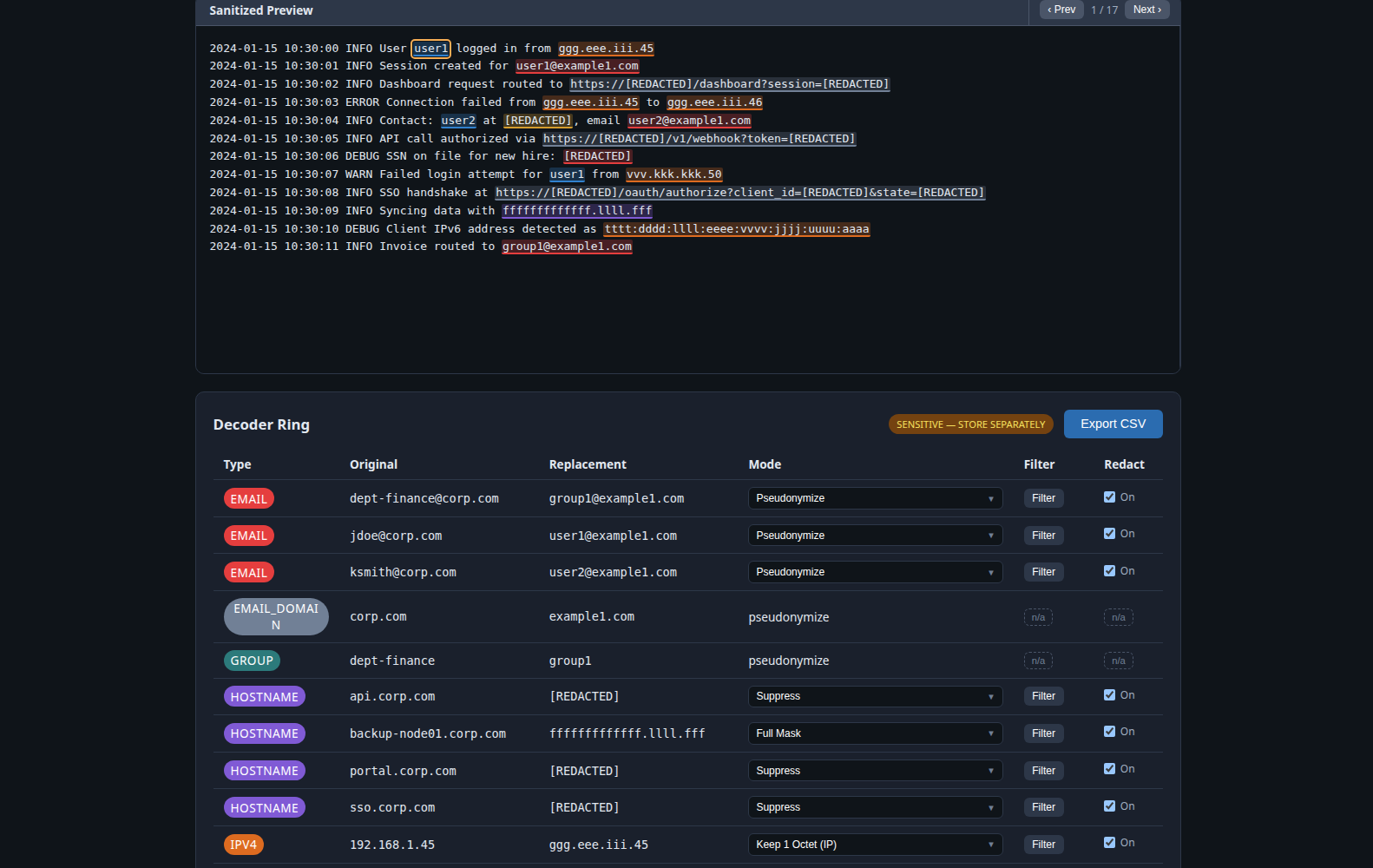
One example: the Decoder Ring — the auditable mapping of every original value to its redacted replacement — is exactly as sensitive as the data it protects, so it's stored locally and never transmitted anywhere either.
Self-hosted. Docker-ready. Nothing to trust but your own infrastructure.